Does Reporting a Taxi Overcharge in Korea Actually Do Anything?
Only about 3 in 100 Seoul taxi reports from tourists ended in a penalty. Why most reports go nowhere, the evidence that changes that, and a reward no one claims.

The short answer
Yes, but only when the report carries proof. Most tourist reports in Seoul end without a penalty because the city cannot confirm what happened. A report with a plate number, a receipt and a card record is a different kind of report.
Where do the reports go?
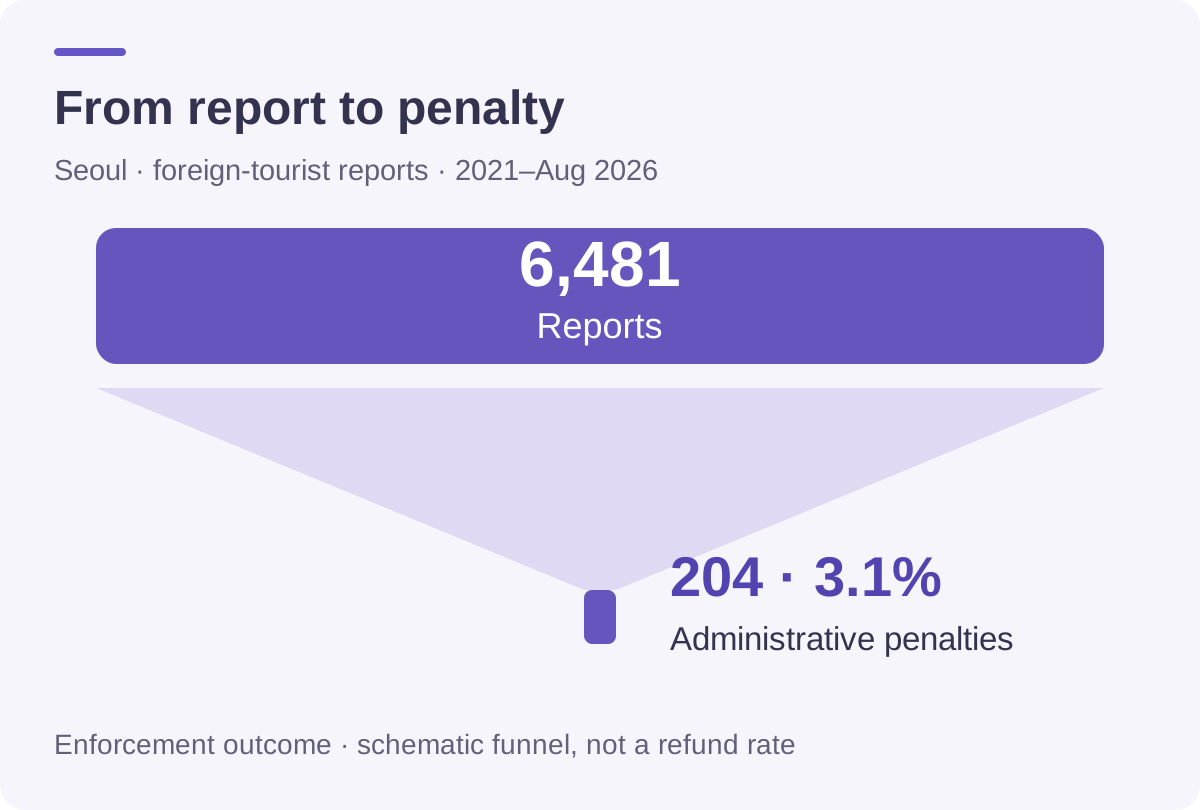
The figures come from Seoul city data released to a National Assembly member in October 2026.
📋 Outcome of 6,481 reports
| Outcome | Cases |
|---|---|
| Administrative penalty | 204 (176 warnings, 26 licence suspensions, 2 cancellations) |
| Guidance or caution, no formal penalty | 1,865 |
| Closed internally by the city | 4,368 (67.4%) |
| — of which "other" (could not confirm, individual circumstances) | 3,253 |
| — of which withdrawn by the reporter | 762 |
| — of which mistaken reports | 271 |
Why "could not confirm" is the biggest category
A tourist reports from memory, often days later and from abroad, with no plate number and a cash payment. The driver says the fare was the meter fare. Without a record, the city has two accounts and no way to decide. The share closed as "other" rose from 38.8% in 2023 to 60.7% by August 2026.
What a report that works looks like
"The meter said one amount. The driver asked for a much bigger one."
- Meter: ₩32,600
- Charged: ₩56,000
- Filed through the in-taxi QR code
What it turns on: the meter record. Because the metered amount and the charged amount were both on record, the city could confirm the overcharge and penalise the driver.
Reports that get closed
- No plate number
- Paid in cash, no receipt
- Filed weeks later from memory
- "He drove a long way round", no route
Reports that get confirmed
- Photo of the plate or the in-car licence
- Card or app payment record
- Receipt showing meter fare and surcharges
- Map screenshot of the route, filed same day
Ask for the receipt, now in English
Since December 2025, Seoul taxi receipts print the final fare, pick-up and drop-off times and any late-night or out-of-city surcharge in English. Foreigner-focused taxi apps also show the toll separately from the fare. Out-of-city surcharge abuse was one of the most common tricks, and the receipt is now where it shows up.
The ₩500,000 reward nobody claims
신고포상금 (reporting reward) Seoul changed its ordinance in 2013 so that when a foreign tourist's overcharge report leads to an administrative penalty, the reporter can receive ₩500,000 (about $350). The tourist who paid the fare can claim it too.
From 2021 to August 2026, 204 reports ended in penalties. Reward claims: zero. Reward payments: zero. The reasons are practical. Anonymous reports are excluded, the claim needs a name, address and phone number, payment comes quarterly to a bank account after an appeal period, and there is no written procedure for a tourist who has already left Korea. The reward was also not mentioned in the city's foreign-language announcements.
The rules are getting stricter
In February 2026 the government announced that taxi overcharging would move from a warning on the first offence to an immediate licence suspension, and the transport ministry published the draft rule in May 2026. Most drivers never overcharge anyone, and a clear record protects them as much as it protects you.
How to file so it counts
- Before you get inPhotograph the plate, or the driver licence card displayed inside.
- Pay by card or appYour statement becomes evidence, and it is also your refund route.
- Take the receiptCheck the surcharge line. Out-of-city surcharges do not apply on many routes, including Incheon Airport to Seoul.
- File the same dayScan the QR sticker in the taxi, or call 120 or 1330. Add the time, route and photos.
- Leave your name if you want the rewardAnonymous reports are not eligible. Ask in writing how a reward would be paid to an overseas account.
The bottom line
Korea is a safe country and the vast majority of taxi rides end at the meter fare. The few drivers who overcharge rely on one fact: tourists report vaguely, late and without proof. A plate photo, a card payment and a receipt are what turn a complaint into a penalty.
File the official report, then write it up publicly. A penalty stops one driver; a public account warns the next passenger before they get in.
Sources
Sources
- SBS Biz — 6,481 reports, 3.1% penalised, reward never paid (Oct 2026)
- Financial News — the same data and the ₩690,800 airport ride (Oct 2026)
- Seoul Metropolitan Government — English receipts, QR reporting, Gimpo case (Jan 2026)
- Government overcharging plan, Feb 2026 — taxi warning replaced by suspension
- Ministry of Land, Infrastructure and Transport — draft taxi rule amendment (May 2026)
Frequently asked questions
What happens when a tourist reports a taxi overcharge in Seoul?
Seoul's city government investigates the driver. Between 2021 and August 2026, 6,481 overcharge reports from foreign tourists led to 204 administrative penalties (3.1%), 1,865 cases of guidance or warnings without a formal penalty, and 4,368 cases closed internally, most often because the violation could not be confirmed.
Can I get my money back after reporting a Korean taxi driver?
Not through the city. Seoul has told foreign complainants that it has no authority to refund fares. The practical refund route is your card issuer or the ride-hailing app's support, which is one reason to pay taxis by card or through an app.
Does Seoul pay a reward for reporting taxi overcharging?
Yes, on paper. Since 2013 a Seoul ordinance has allowed a ₩500,000 reward when a foreign tourist's overcharge report leads to an administrative penalty, including for the passenger who paid. Anonymous reports are excluded, and from 2021 to August 2026 not a single reward was applied for or paid.
How do I report a taxi in Seoul as a foreigner?
Scan the QR code sticker inside Seoul taxis to file a multilingual complaint, call 120 (Dasan Call Center) or 1330 (Korea Travel Hotline), and include the plate number, time, route, receipt and payment record.
Read real traveler experiences
MyKoreaReview collects first-hand accounts from international travelers in Korea — the good and the difficult.
Browse experiences