Korea's 2026 Crackdown on Tourist Overcharging: What Actually Changed
Korea announced a broad plan against overcharging in February 2026. Which rules are already in force for hotels, homestays and festivals, and which are still coming.

The short answer
Korea has made overcharging a one-strike offence for lodging, and is moving taxis, restaurants and rental cars the same way. For a visitor, the practical change is that a posted price now carries real weight, so photograph it.
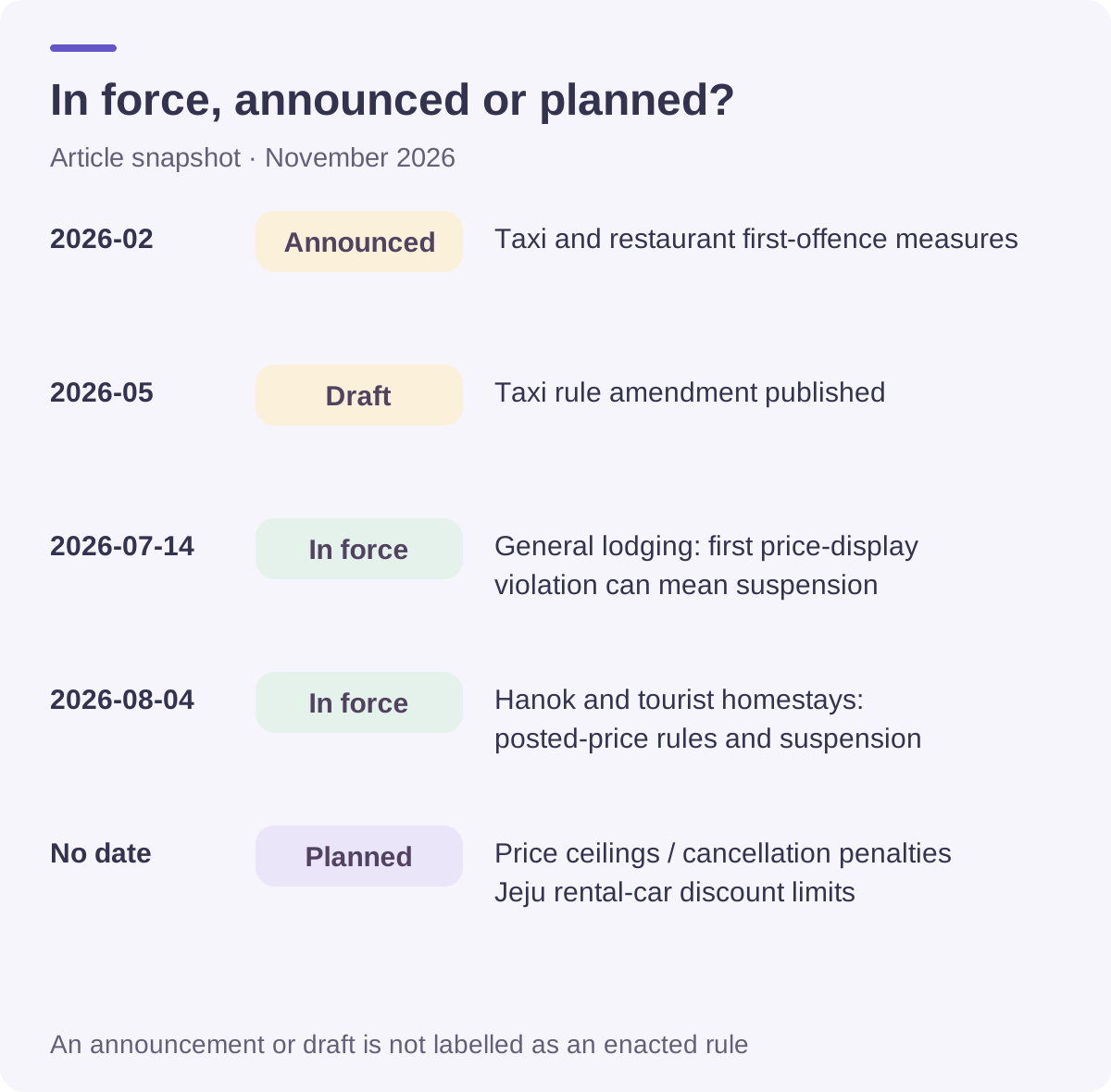
📌 Where each measure stands (November 2026)
| Sector | Measure | Status |
|---|---|---|
| Hotels and general lodging | Suspension on first price-display violation | In force since 14 July 2026 |
| Hanok stays, foreign-tourist homestays | Must post rates; 5-day suspension on first violation | In force since 4 August 2026 |
| Taxis | First overcharge: suspension instead of warning | Announced Feb 2026; draft rule May 2026 |
| Restaurants | Suspension on first price-display violation | Announced Feb 2026 |
| Hotels during events | Seasonal price ceilings registered in advance | Planned |
| Hotels | Penalties for cancelling bookings without valid reason | Planned |
| Jeju rental cars | Cap on off-peak discounts to narrow peak markups | Planned |
Why it happened
바가지요금 (bagaji-yogeum) means an inflated price charged to someone who does not know better. In 2025 and 2026 it stopped being a local story. Tourist complaints filed with the Korea Tourism Organization reached a record 1,744 in 2025, and the 2025 total was passed by July 2026.
"The hotel cancelled my concert-week booking for 'overbooking', then listed the same room at about five times the price."
- Concert-night rates averaged 2.4× normal weekends
- Police opened fraud investigations
What it turns on: the gap in the old rules. Posting a high price was legal; there was little to stop a business from undoing a cheaper booking. The 2026 plan targets exactly that gap.
The February 2026 plan in one paragraph
Announced at an expanded national tourism strategy meeting on 25 February 2026, the plan added posted-price obligations for lodging types that lacked them, moved first violations from warnings to suspensions, proposed a seasonal price-registration system for lodgings, promised penalties and compensation rules for unilateral booking cancellations, capped Jeju rental-car discounting, and increased funding for "good price" businesses from ₩3.1 billion in 2025 to ₩4.9 billion in 2026.
What it means on the ground
Before
- First violation: correction order or warning
- Homestays had no rate-posting rule
- Event-week cancellations hard to sanction
- Festival prices set stall by stall
Now or coming
- First violation: suspension for lodging
- Hanok and homestays must post and keep rates
- Cancellation penalties planned
- Festival menus published and checked
A rule only works with a record
Enforcement still depends on evidence. In Seoul, only 3.1% of foreign tourists' taxi overcharge reports from 2021 to August 2026 ended in a penalty, mostly because the city could not confirm what happened. Photograph posted prices, keep receipts and pay by card.
What to do as a visitor
- Photograph the posted priceRoom rate at the desk, menu board, taxi meter. The 2026 rules are about posted prices.
- Pay by card or through a platformYour statement is evidence and your refund route.
- Refuse extra charges in writingFor a confirmed booking, reply in the platform chat that you will not pay more.
- Report through 1330Interpretation and complaints in several languages, including English, Japanese and Chinese.
The other side of the plan
The plan is not only penalties. It funds "good price" businesses, gives financial incentives to local governments that keep prices stable, and adds penalties in government support programmes for businesses reported for overcharging. Most Korean businesses already price honestly; the aim is to make that visible and the exceptions costly.
The bottom line
Korea is a safe, well-run country to visit, and in 2026 it changed its rules because a minority of businesses had learned that tourists rarely complain. Lodging rules already bite on the first offence; taxi and restaurant rules are following. A photographed price and a card payment are what let those rules work for you.
If a business charged more than it posted, report it to 1330 and write it up publicly. Official complaints are what the new penalties are built on.
Sources
Sources
- Government overcharging plan, 25 Feb 2026 — full list of measures
- Kyunghyang Shinmun — lodging suspensions from 14 July and 4 August 2026
- Seoul Metropolitan Government — taxi overcharge penalty table (updated March 2026)
- Ministry of Land, Infrastructure and Transport — draft taxi rule amendment (May 2026)
- Financial News — record tourist complaints, 1,753 in Jan–Jul 2026
- SBS Biz — 3.1% of Seoul taxi reports penalised (Oct 2026)
Frequently asked questions
What did Korea change in 2026 to stop tourist overcharging?
In February 2026 the government announced a plan covering lodging, restaurants, taxis and rental cars. By August 2026, lodging businesses including hotels, hanok stays and foreign-tourist homestays faced a business suspension on the first violation of posted-price rules, instead of the earlier correction order.
Do Korean taxis now lose their licence for overcharging on the first offence?
The government announced in February 2026 that a first taxi overcharging offence would bring an immediate qualification suspension instead of a warning, and the transport ministry published a draft rule amendment in May 2026. Check the current rule before relying on it; a warning-first system was still described on Seoul's site in March 2026.
What is Korea's 'bagaji-free price system' for hotels?
It is a planned system in which lodging businesses register their price ceilings for off-peak, peak and special-event periods with local government in advance, and publish them. Charging above the registered ceiling or not registering would bring penalties such as business suspension.
Where do I report overcharging in Korea?
Call 1330, the Korea Travel Hotline, which handles interpretation and tourist complaints in several languages. In Seoul you can also call 120 or scan the QR code inside taxis. For refunds, dispute the charge with your card issuer or booking platform.
Read real traveler experiences
MyKoreaReview collects first-hand accounts from international travelers in Korea — the good and the difficult.
Browse experiences