Airbnb and Hanok Stays in Korea: Legal Status and 2026 Rules
Korea removed unregistered Airbnb listings and, from August 2026, can suspend hanok and homestay hosts on a first price violation. What to check before you book.

The short answer
Book a registered stay, through a platform, by card. Since 2026 the legal status of a Korean Airbnb is visible on the listing, and registered hanok and homestay hosts now face a business suspension the first time they charge more than their posted price.
- Listing shows a business registration number or "registered" details
- Full street address that appears on a map before you pay
- Price and extra fees shown on the platform, paid on the platform
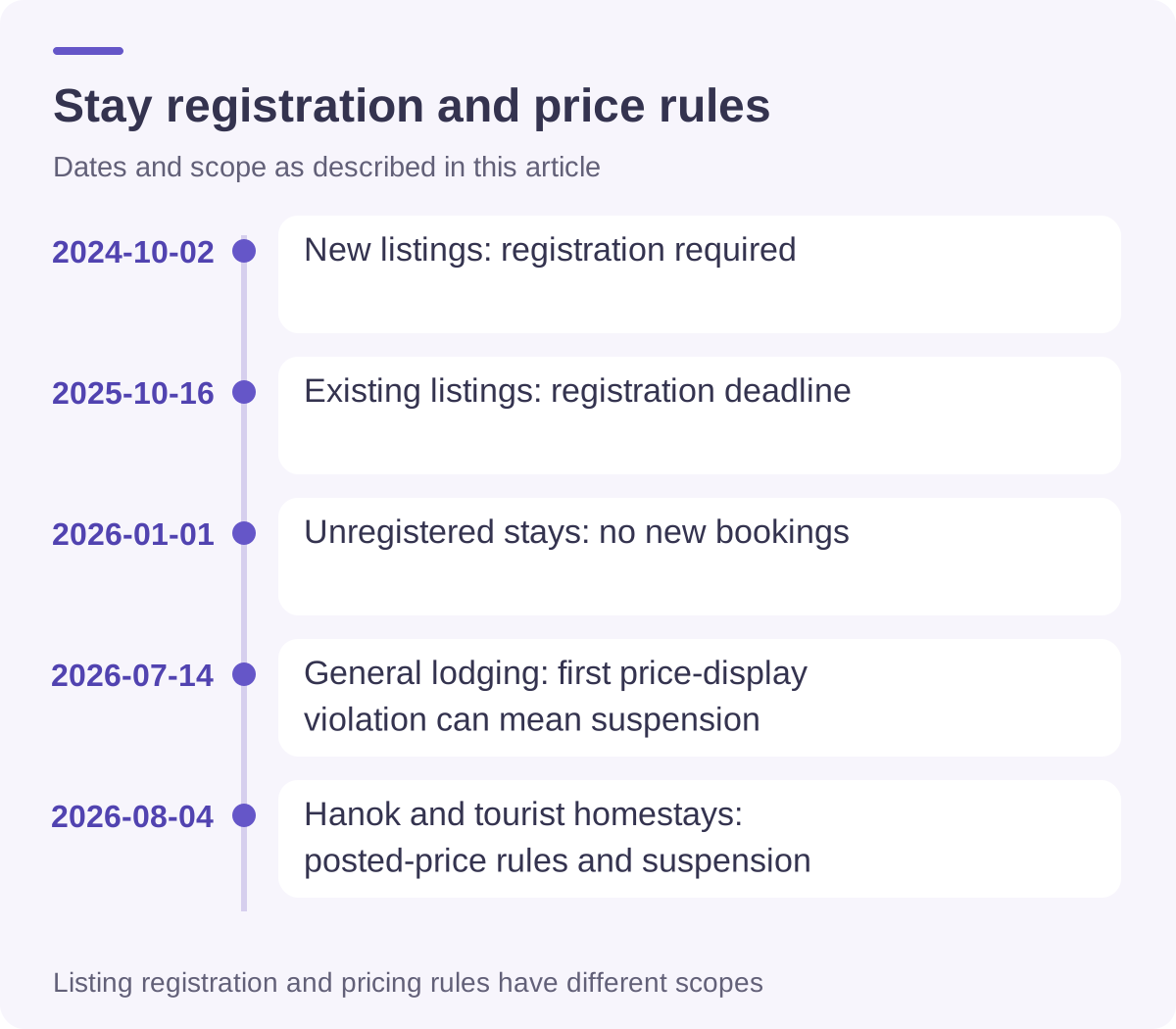
What changed, and when
외국인관광 도시민박업 is the Korean category for a city home rented to foreign tourists, a "foreign-tourist urban homestay". It is the legal basis for most private city rentals that foreigners book.
🏠 The timeline
| Date | Change |
|---|---|
| 2 Oct 2024 | New Airbnb listings in Korea must submit a business registration before hosting |
| 16 Oct 2025 | Deadline for existing listings to submit registration |
| 1 Jan 2026 | Unregistered existing listings can no longer take bookings for stays from this date |
| 14 Jul 2026 | General lodging: first-time price display violation becomes a business suspension |
| 4 Aug 2026 | Hanok stays and foreign-tourist urban homestays: posted-price rules with suspension from the first violation |
Why officetel rentals disappeared
Many cheap, central "Seoul studio" listings were in officetels, a building type that generally cannot be registered for lodging. Airbnb said such listings would leave the platform once registration became mandatory. In 2025 Taiwanese media warned travelers about the change, and hosts reported a wave of messages asking for licence numbers.
What the 2026 price rules mean for you
Before August 2026, a first violation by these businesses brought only a correction order. The change followed the government's February 2026 plan against overcharging, which also promised penalties for unilateral booking cancellations.
"At check-in the host said the price on the app didn't include a 'cleaning and foreigner service fee' and asked for cash."
- Extra fee not shown on the listing
- Cash requested at the door
What it turns on: the posted price. A registered homestay must charge what it posts. An extra fee that appears only at the door is exactly what the 2026 rules target.
Before you book
- Find the registrationOn Airbnb, Korean listings show business registration information. If it is missing, choose another listing.
- Check the address on a mapA registered property has a real street address. "Near Hongdae station" is not an address.
- Read the fee breakdownCleaning fees and taxes should be on the platform before you pay, not at the door.
- Never pay off-platformA request to "pay the host directly for a discount" removes your dispute route.
- Screenshot the listingPrice, fees and house rules at the time of booking.
Red flags
- No registration details on the listing
- Address only after payment
- "Pay by bank transfer and save 10%"
- New fees announced at check-in
Good signs
- Registration shown on the listing page
- Exact address on a map
- All fees in the platform total
- Host answers questions before you fly
Why a hanok stay is still worth it
Staying in a traditional hanok in Bukchon, Seochon or Jeonju is one of the most memorable things a visitor can do in Korea, and travelers regularly describe hosts who serve breakfast, explain the house and help plan the next day. The new rules protect that experience; they are aimed at the few hosts who treat a posted price as a starting point.
The bottom line
Korea is a safe place to rent a room, and registered hosts are the norm on the major platforms since 2026. Choose a listing with visible registration, pay the full price through the platform, and keep a screenshot. If a host asks for more at the door, the law is now on your side from the first offence.
If a host charged an unposted fee, report it to 1330 and write a review that names the fee. Hosts read reviews; the next guest reads them more carefully.
Sources
Sources
- Airbnb Help Centre (Korea) — business registration requirement and deadlines
- Airbnb Newsroom — mandatory registration for existing listings from 16 Oct 2025
- Kyunghyang Shinmun — hanok and urban homestay suspensions from 4 Aug 2026
- News1 — Taiwanese travelers' concerns over unregistered stays (Sept 2025)
Frequently asked questions
Is Airbnb legal in Korea?
Yes, for registered listings. In cities, a home rented to foreign tourists generally needs to be registered as a foreign-tourist urban homestay, and Airbnb has required Korean listings to submit a business registration. Since 1 January 2026, existing listings without one cannot take bookings, and the registration details are shown on the listing page.
Why were officetel Airbnbs removed in Korea?
Officetels (studio buildings zoned for business or residential use) generally cannot be registered for lodging in Korea, so they cannot obtain the business registration Airbnb now requires. Listings that could not register were removed or stopped taking bookings for stays from 2026.
What happens if a Korean homestay or hanok charges more than its posted price?
Since 4 August 2026, a foreign-tourist urban homestay or hanok experience business that fails to post its rates or charges more than posted faces a 5-day business suspension on the first violation, 15 days on the second, one month on the third and cancellation of registration on the fourth.
How do I check if a Korean guesthouse is registered?
On Airbnb, look for the business registration information on the listing page. On any platform, a registered property gives a full street address that appears on a map and can show its registration on request. Be cautious with listings that reveal the address only after payment or ask you to pay outside the platform.
Read real traveler experiences
MyKoreaReview collects first-hand accounts from international travelers in Korea — the good and the difficult.
Browse experiences